
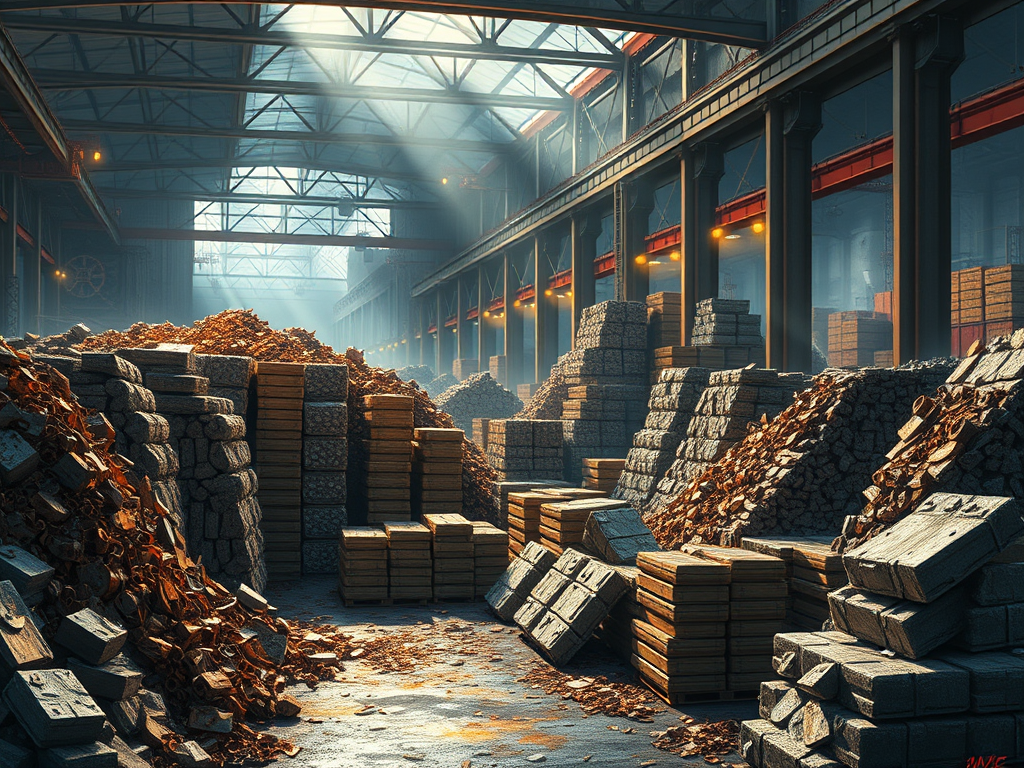
When Economic Slowdown Meets a Metal Boom
At first glance, today’s metal markets look counter-intuitive.
Global economic growth is slowing. Manufacturing indicators remain weak in many regions, consumer demand is cautious, and traditional construction and infrastructure investment is no longer expanding at the pace seen in previous cycles.
Under classical commodity logic, this environment should suppress metal prices. Yet copper, silver, and gold continue to trade near historic highs, and in some cases are still pushing upward.
This is not a market anomaly. It is a signal that metals are no longer priced purely as industrial raw materials. They are increasingly priced as strategic assets, geopolitical hedges, and infrastructure for the next technological era.

Geopolitics Has Turned Metals into Strategic Assets
Over the past decade, geopolitics has quietly reshaped commodity pricing. Supply security now matters almost as much as supply volume.
Conflicts, sanctions, export controls, and trade fragmentation have exposed the vulnerability of global supply chains. Governments and major industrial players no longer assume that critical metals will always be available on open markets at stable prices.
As a result, stockpiling behavior has changed. Strategic metals such as copper, nickel, tungsten, molybdenum, and rare alloying elements are increasingly treated as national or corporate security assets. This behavior tightens markets even when end-user demand softens.
Prices today reflect not only current consumption, but also future uncertainty. In geopolitical terms, metals are being priced for risk, not just usage.

Economic Competition Is Reshaping Demand, Not Destroying It
While global growth is slowing, competition between major economies has intensified. Industrial policy, re-industrialization, and supply-chain localization have become long-term strategies rather than short-term responses.
From defense manufacturing to energy infrastructure and high-end equipment, metals sit at the very foundation of national competitiveness. This means that even in a weaker economic environment, governments and strategic industries continue to invest.
In practical terms, this shifts metal demand away from purely cyclical sectors and toward structural, policy-driven demand. The volume may fluctuate, but the baseline remains elevated.
This is why metal prices are no longer moving in lockstep with GDP growth.
AI and the Compute Revolution: A Hidden Demand Engine
One of the most underestimated drivers of metal demand is artificial intelligence and digital infrastructure.
AI is not a “light” industry. It is extremely resource-intensive. Data centers, high-performance computing clusters, advanced cooling systems, power transmission upgrades, and grid stabilization all require massive amounts of copper, aluminum, silver, and specialty alloys.
Unlike consumer markets, AI investment is front-loaded and strategic. Governments and leading technology companies continue to deploy capital even when economic growth slows, because compute capacity is viewed as a long-term advantage.
In this sense, the AI cycle is not synchronized with the traditional economic cycle. As long as digital infrastructure continues to expand, certain metal markets retain strong structural support.

Financial Capital Amplifies, But Does Not Create, the Trend
Financial flows undeniably amplify metal price movements. Expectations of lower interest rates, currency volatility, and inflation hedging all drive capital toward hard assets.
However, it is important to distinguish amplification from causation. Without real supply constraints, geopolitical risk, and genuine industrial demand, speculative capital would not sustain these price levels for long.
What we are seeing today is not a purely financial rally. It is a structurally supported market with heightened volatility.
So How Long Can the Surge Last?
The more relevant question is not whether prices will correct, but how the cycle evolves.
A prolonged, uninterrupted price surge is unlikely. Markets eventually react to substitution, demand elasticity, and supply responses. However, a full return to pre-cycle price levels also appears increasingly unrealistic.
The most probable outcome is a prolonged period of high-level volatility:
- Some metals tied closely to traditional industries may face corrections.
- Strategic and technology-linked metals are more likely to trade in elevated ranges, even during economic slowdowns.
- Price cycles may shorten, but price floors are likely to remain higher than in previous decades.
This suggests a shift in the long-term pricing regime rather than a temporary spike.
Conclusion: Metals Are Entering a New Pricing Era
The current metal price surge is not simply defying economic gravity. It reflects a deeper transformation in how metals are valued.
Geopolitical fragmentation, strategic competition, AI-driven infrastructure, and supply constraints have collectively weakened the old relationship between economic growth and metal prices.
While extreme rallies cannot last forever, the idea that metal prices will return to “cheap and abundant” conditions looks increasingly outdated.
We are no longer in a purely cyclical metal market.
We are in a strategic metal era, where volatility replaces stability—and where price strength can persist even in a slowing global economy.
